/Engineering9 min read
Your Small Model Can Learn to Search Like a Frontier Model
I fine-tuned Qwen3.5-4B on a few thousand search trajectories from Kimi K3. It learned to chase several clues at once and now answers as well as a model twice its size.

In production, you usually want a small open model running your search agent because it is cheap enough to call on every request, and you can host and tune it yourself. The problem is that most small models meet a search tool for the first time when you wire one up. Pre-training taught them plenty about the web, but they were trained to process information, not find it.
That gap shows up as soon as you read their traces on hard questions. Give an untrained Qwen3.5-4B a search tool and a multi-clue question, and it picks one plausible thread, searches it, reads what comes back, then searches a little further along the same thread. It looks sensible until a question has five clues and the model is still chasing its first idea when the step budget runs out. Kimi K3, the open frontier model I used as the teacher in this experiment, works the other way round. Its early steps are wider and messier: it pulls the question apart, searches several clues at once, reads what comes back, and only then starts narrowing down.
I wanted to know whether that search habit was something a 4B model could be taught, or whether it was just what a much larger model does. So, I ran Kimi K3 with Tavily on a set of hard research questions, kept 3,241 trajectories where it reached the right answer, and fine-tuned Qwen3.5-4B on them.
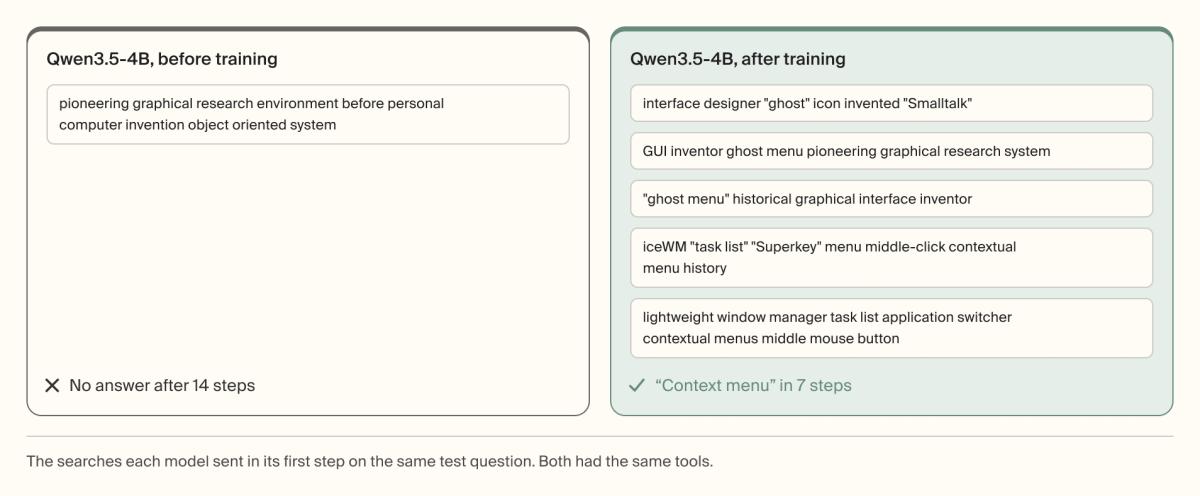
After training, the 4B approaches a question the way Kimi does. It now matches Qwen3.5-9B on our held-out test questions and edges past it on BrowseComp, a public benchmark it never trained on. It is also considerably slower than it was. Both of those came from the same change, and the second one has some interesting nuances that I want to unpack.
Three test questions, before and after training
These are test questions the untrained 4B got wrong and the trained one got right. Here, I also include the trajectory the untrained 9B took on the same questions, running with the same tools and the same limits.
“This interface element first appeared in a pioneering graphical research environment, documented before the widespread adoption of the personal computer. Its inventor, who also contributed to a seminal system built on an object-oriented paradigm, described its appearance with a term denoting ephemerality. To access this element in a lightweight window manager known for integrating a graphical task list and a keyboard-based application switcher, one must perform a non-primary action with a pointing device. The element's common designation references its contingent relationship to the user's current spatial focus within the graphical plane. What is the standard two-word term for this element?”
Expected answer: Context menu
Incorrect answer
- 14 steps
- 14 searches
- 0 page reads
Full answer
The model stopped searching without writing an answer.
Correct answer
- 7 steps
- 32 searches
- 3 page reads
Full answer
The clues point to Dan Ingalls’s pop-up menu for Smalltalk/Xerox Alto. He helped create Smalltalk and continued contributing to its open-source descendant Squeak. Modern documentation ties right-clicking to displaying this type of menu, while IceWM provides a task list and keyboard application switching. Its choices are tied to the current graphical context or focused object.
The encryption question is the clearest of the three. The clues describe RC6, one of the finalists in the competition that produced AES. Before training, the 4B spent all 25 of its steps circling Rijndael instead. Rijndael is the finalist that won, so it dominates the search results, and the model kept finding more confirmation for the answer it already had in mind. After training, it searches MARS, RC6, Serpent, and Twofish side by side, checks them against the clues, and answers RC6.
Same steps, three times the searches
Training did not make the 4B take more steps. It takes about 13 per question, as it did before. However, it made each step wider. The model now sends about three times as many searches in total, and more than half of its steps fire off four or more searches or page reads at once. Before training, it almost never did that. Kimi does it in most of its steps.
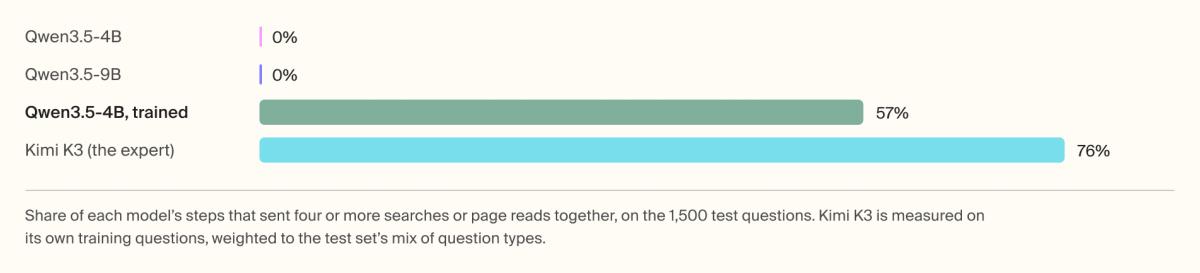
This works because the harness caps each run at 25 steps, not 25 searches. In a single step, the model can emit as many tool calls as it wants and the harness executes them in parallel before returning the results for the next turn. The untrained 4B treated each step as a single search anyway, so on hard questions it burned through all 25 steps before it had checked every clue. The trained model packs multiple lookups into a turn and uses what comes back together to decide where to go next. On the hardest puzzles it now runs about 74 searches per question instead of 25, in the same number of steps — and those are the questions where its accuracy improved most.
The trade-off is latency. Because each step now pulls back several search results and pages, and the model reads and reasons over a much larger context on the next turn, median time per question went from under two minutes to about five, and to nearly nineteen minutes on the hardest puzzles. Every run had a 30-minute timeout, and any run that timed out was marked wrong. Neither untrained model ever hit that ceiling; the trained 4B timed out on about 8% of the test set (127 questions). Searching wider bought accuracy at the cost of wall-clock time.
What does this mean in production? From my work as an FDE, I've seen that every use case has its own latency and accuracy trade-offs. Training taught the 4B both to search in parallel and to handle the larger context that comes back — two things the base model struggled with.
Level with the 9B, including on BrowseComp
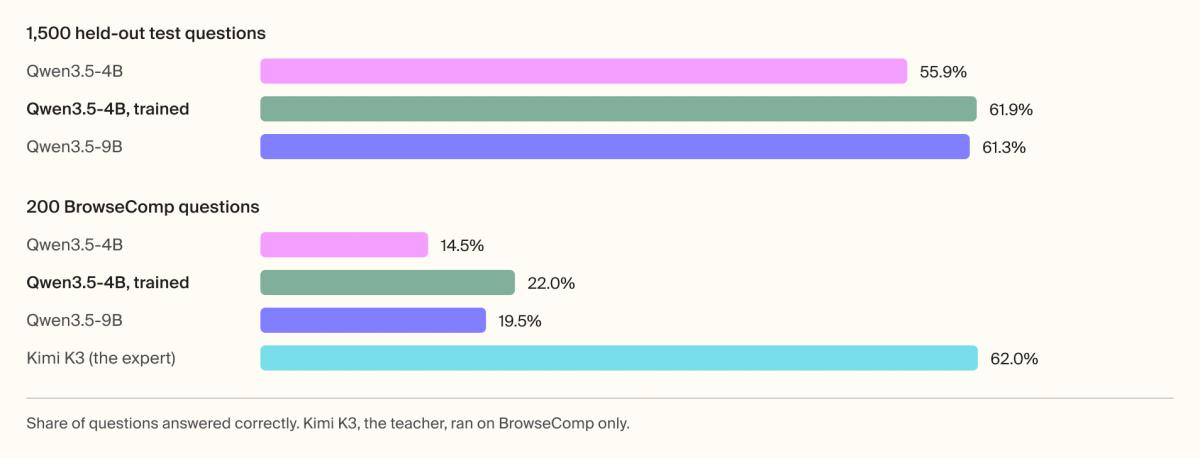
On the 1,500 held-out test questions, training took the 4B from 56% to 62%. The 9B scored 61%, so I would call them level. Question by question, training fixed twice as many answers as it broke. The trained model pulled ahead of the 9B on the hardest puzzles, but the 9B is still clearly better on open-ended research questions.
Our 1,500 test questions were held out from the same four datasets we used for training, so BrowseComp is the stricter out-of-distribution check. On 200 BrowseComp questions, the trained 4B went from 14.5% to 22.0%, essentially tied with the 9B at 19.5%. Kimi K3 is still far ahead at 62%. Training taught the small model how Kimi searches, not everything Kimi knows.
Where the training data came from
I did not start with Kimi. I started by running the untrained 4B over 15,483 training questions, to find out where it fails. It solved about nine in ten of the two-step lookups and only about one in five of the hardest puzzles. Sending Kimi questions the student could already answer would mostly have produced short, easy runs of a kind the student did not need to copy. So, Kimi got the 4,675 questions the 4B missed, plus 800 it had solved, which ensured the training data still contained some quick, straightforward runs.
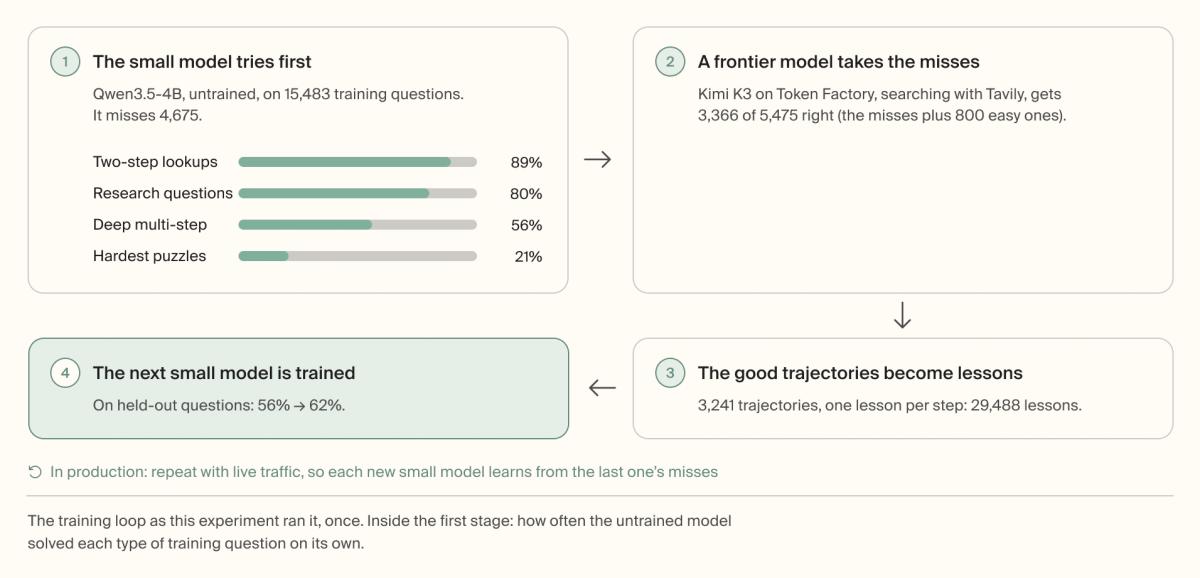
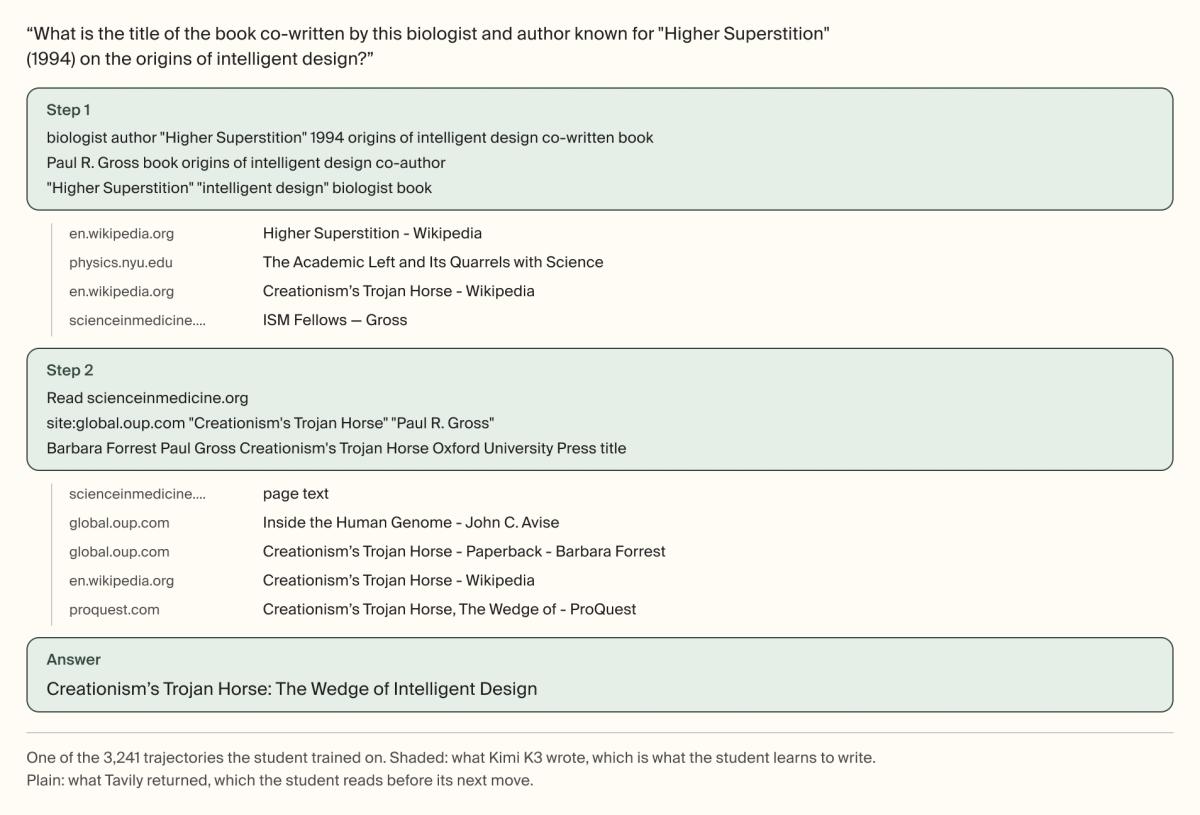
Kimi got 3,366 of its 5,475 questions correct. I kept 3,241 of those runs; the rest were dropped because they were malformed or contained steps that were too long to use for training.
This is the loop Tavily sees teams building in production: a small model takes what it can, a frontier model catches what it misses, and the catches become the next round of training data. Here it ran once, offline, on a fixed set of questions.
Kimi ran on Nebius Token Factory, which serves open models behind an OpenAI-compatible API. Kimi ran in the same harness as the student, with the same Tavily tools, where the only change was the model name. Tavily ran every search in the project, from the student's first pass through to the final evaluations.
For training, I split each kept trajectory into one example per step (29,488 in total). Because the harness trims older search results to titles and URLs after three turns to keep context manageable, each step has a slightly different view of the conversation history. Every training example pairs the exact context Kimi saw at that turn (the question, its prior steps, and the full Tavily results for recent turns) with the move Kimi made next. That way the student learns both how to write queries and how to react to the results that come back.
Running this on your own traffic
Nothing changed at inference. The trained 4B uses the same prompt, the same two tools (Tavily Search and Tavily Extract), and the same limits as before. The behavior is in the weights, which is the whole point: a few thousand good trajectories were enough to change how the model searches, with no scaffolding around it.
NVIDIA did this at much larger scale, post-training its deep-research agent on Tavily trajectories — about 67,000 trajectories on 128 H100s. This run used 3,241 trajectories and eight GPUs. The gap between those two numbers is a function of scale. You do not need a lab's budget to find out whether it works on your questions.
Your version starts where mine did: run the small model, find out where it fails, and send those cases to a frontier model searching with Tavily. Keep the runs that pass your grader and train on them. My grader compared answers against reference answers, which is easy mode. On live traffic you need a judge model or some other signal you trust.
That is the hard part, because it decides what the next model learns to call a good answer. Because you own the weights, what your traffic teaches the model stays in your stack, not in a model your competitors can rent too.
If I run a second round, I know where I would start. I kept every correct Kimi run regardless of how long it took, and the student duly learned to be thorough and slow. Being stricter about long, meandering teacher runs by keeping the wide first steps and dropping the ones that wander, is the most obvious way to keep the accuracy and buy some of the time back.
Search is no longer just how agents know. It's how they learn.