
/Product4 min read
Your AI Runs in Europe. Does its Search?
An EU-hosted model doesn’t guarantee EU-based search. Simba’s story shows how Tavily keeps query processing within an approved EU boundary.

At GTC Berlin, we’re previewing Tavily’s EU query residency offering. It addresses a gap that’s easy to miss until it’s too late: an AI application can run its model in Europe while sending search queries elsewhere.
To explain, meet Simba, our founder’s dog. For this story, he’s running product development at a fictional Berlin dog-treat company. His specialty: biscuits made with German-grown potatoes. His commitment to taste-testing is unmatched.
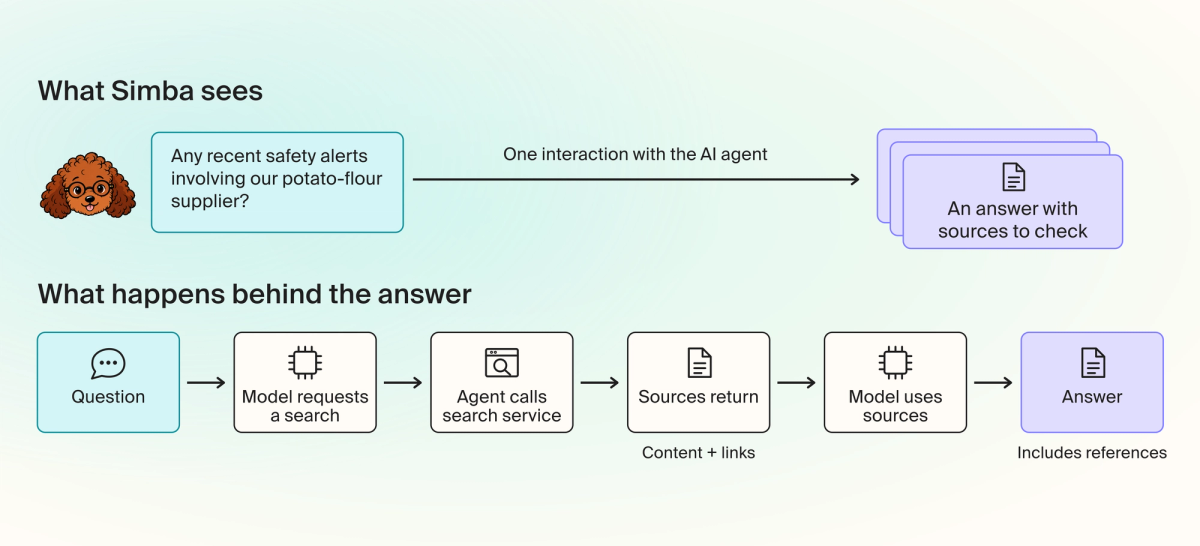
The product is in demand and the company is expanding across the EU. Before its next launch, Simba asks his assistant: “Have there been any recent recalls or safety alerts involving our potato-flour supplier?”
This assistant is an AI agent: it uses a model to interpret questions and can call tools, including web search, to gather information before answering.
Simba needs current evidence to share with the quality team. A relevant alert could mean investigating a supplier or holding an ingredient batch. The assistant helps him find the notices; the quality team checks the details.
The model stayed in Europe…
The company’s developers built the agent around an EU-hosted model. Its security lead requires product-development queries to be processed in the EU because they can contain confidential supplier and launch information.
To answer Simba’s question, the model requests a web search that includes the supplier’s name. The agent sends that query to its configured search service, receives source material, and passes it back to the model to prepare an answer.
Simba sees a useful response with links. What he doesn’t see is where the search ran.
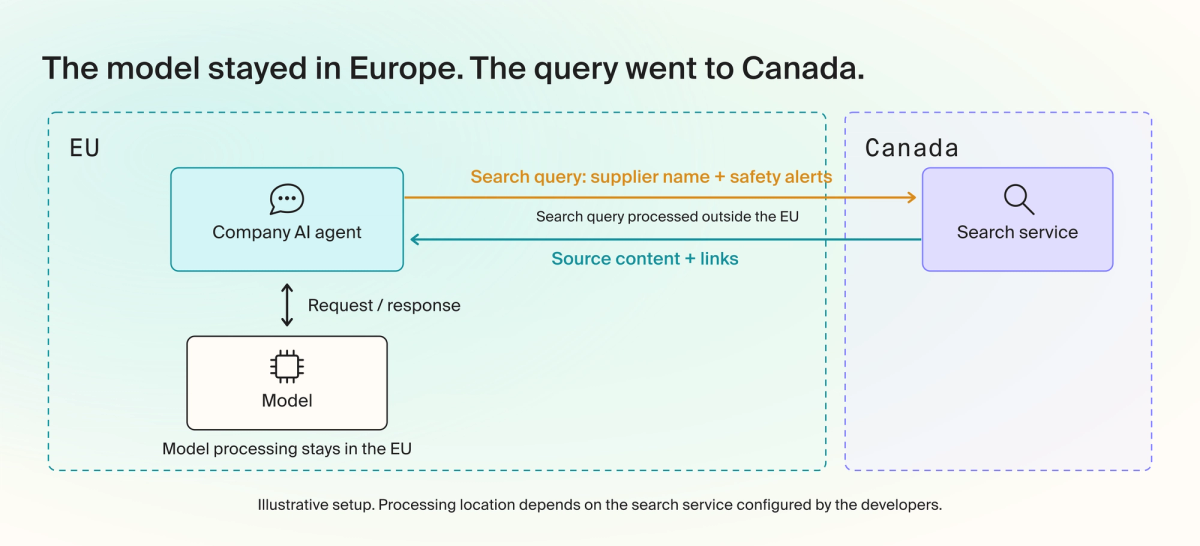
In this fictional setup, the developers connected the agent to a search service that processes requests in Canada.
Note: Canada is illustrative here. Tavily’s standard endpoint processes queries in the U.S., which is why we built an EU endpoint for customers who require EU query processing.
A useful answer with an unexpected detour
Before making the agent available across the company, the developers and security lead review where it sends data. They trace Simba’s search request and discover the Canadian processing location.
The agent doesn’t meet the company’s EU-processing requirement. Wider rollout pauses until the developers change the search integration.
These are not small potatoes.
The request includes the supplier’s name. The information Simba wants may be public, but his company’s interest in that supplier is business context. A more detailed query could reveal an ingredient concern or sensitive plans for an unannounced product.
The developers control which search service the agent calls and what information it sends. They need to bring search processing within the same EU boundary they chose for the model.
What an EU endpoint means
An endpoint is the service address an application sends requests to. For Tavily’s EU API, that address is https://api.eu.tavily.com.
The important part is what happens behind that address. Tavily’s EU endpoint processes queries using its own search index and EU-based subprocessors. API services run in Frankfurt; the index and search runtime run on Nebius infrastructure in France. Logs and monitoring run in Europe too.
“EU” describes where query processing happens. Using Tavily, Simba can still research suppliers and information from around the world.
Once access is enabled, the developers can configure the agent to send searches to Tavily’s EU endpoint. Choosing an EU-hosted model doesn’t automatically configure its search tools.
They can also enable zero query retention in their account settings, giving them a separate control over what happens after processing. The residency commitment covers query data; account, support, usage, and billing data, along with redacted analytics, remain in shared U.S. systems.
Simba’s agent takes a different route
Here’s what the revised setup could look like: Simba’s AI research agent keeps using an EU-hosted model, while its developers route web searches through Tavily’s EU endpoint.
Simba asks about his potato-flour supplier. The model requests current information. The agent sends the search request to Tavily’s EU endpoint, then passes the returned evidence back to the model to prepare an answer with sources.
Before rollout, the developers test search quality and confirm the configured endpoints. The security lead checks processing locations, subprocessors and retention settings against the company’s requirements.
The goal is straightforward: give Simba access to current web information while keeping the agent’s query processing within the approved EU boundary.
Simba can get back to investigating ingredients. And conducting another rigorous taste test.
Building an AI agent with EU query residency requirements? Learn more about how Tavily can help and subscribe to receive updates on supported features.