/Product4 min read
Tavily vs. Claude Web Search: When Native Search Isn’t Enough
See how Tavily performed in comparison to Claude’s native web search in accuracy and cost per correct answer, while adding control, visibility, and flexibility.

One of the most common questions we get asked is: Why use Tavily when Claude already has native web search?
It’s a fair question. Native web search is convenient. Give Claude access to the web, and it can search for current information without adding another API to your stack.
For prototypes and applications built entirely around Claude, that may be all you need.
But once web search becomes a core part of a production agent, the requirements change. You need control over what gets retrieved, visibility into what your agent searched, and predictable behavior as you change models. Most importantly, you need retrieval quality that gives your model the right context without filling its context window with noise.
That’s where a dedicated search layer like Tavily starts to matter.
Better retrieval gives Claude better context
The quality of an agent’s answer depends heavily on the context it receives.
To understand the difference between Tavily and Claude’s native web search, we tested them head-to-head on SealQA-Hard, a set of 254 questions designed to require finding and combining information from across the web.
We kept the outer model, system prompt, search budget, and evaluation setup identical. The only variable we changed was the search API: Claude native web search vs. Tavily Advanced Search.
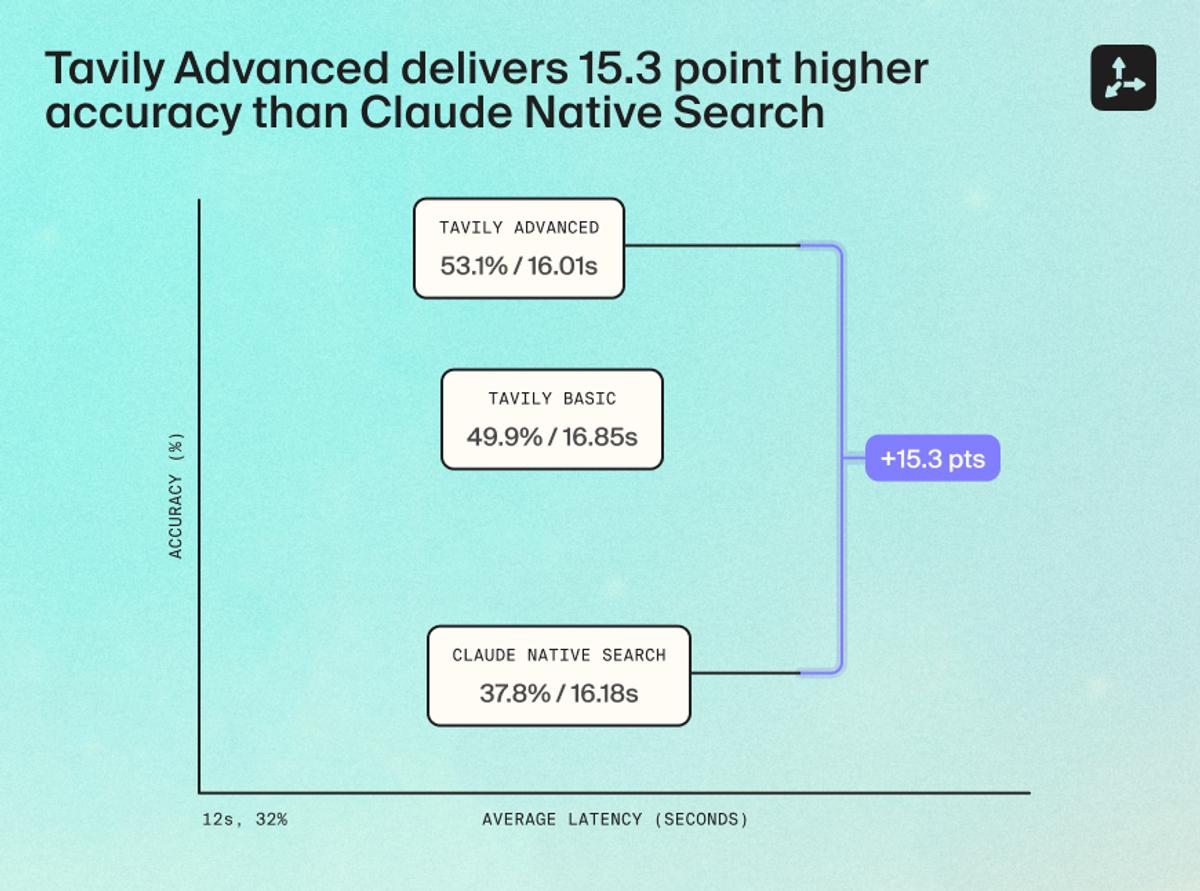
Tavily Advanced delivered 15.3% points higher accuracy than Claude native search, with comparable latency.
Every search result consumes context. But more context isn't necessarily better context. Irrelevant or redundant content gives the model more information to sift through without necessarily helping it reach the right answer.
Tavily is designed to return highly relevant, information-dense results, giving Claude more useful context to reason over. In our evaluation, that translated into substantially higher accuracy than Claude’s native web search.
Better retrieval lowers inference costs
The cost of web search isn’t just the price of the search API. Every token your model has to read also costs money.
Across 254 SealQA-Hard questions, Tavily Basic used 40% fewer tokens than Claude’s native web search, while Tavily Advanced used 15% fewer.
The difference becomes even clearer when you look at the cost of getting a correct answer:
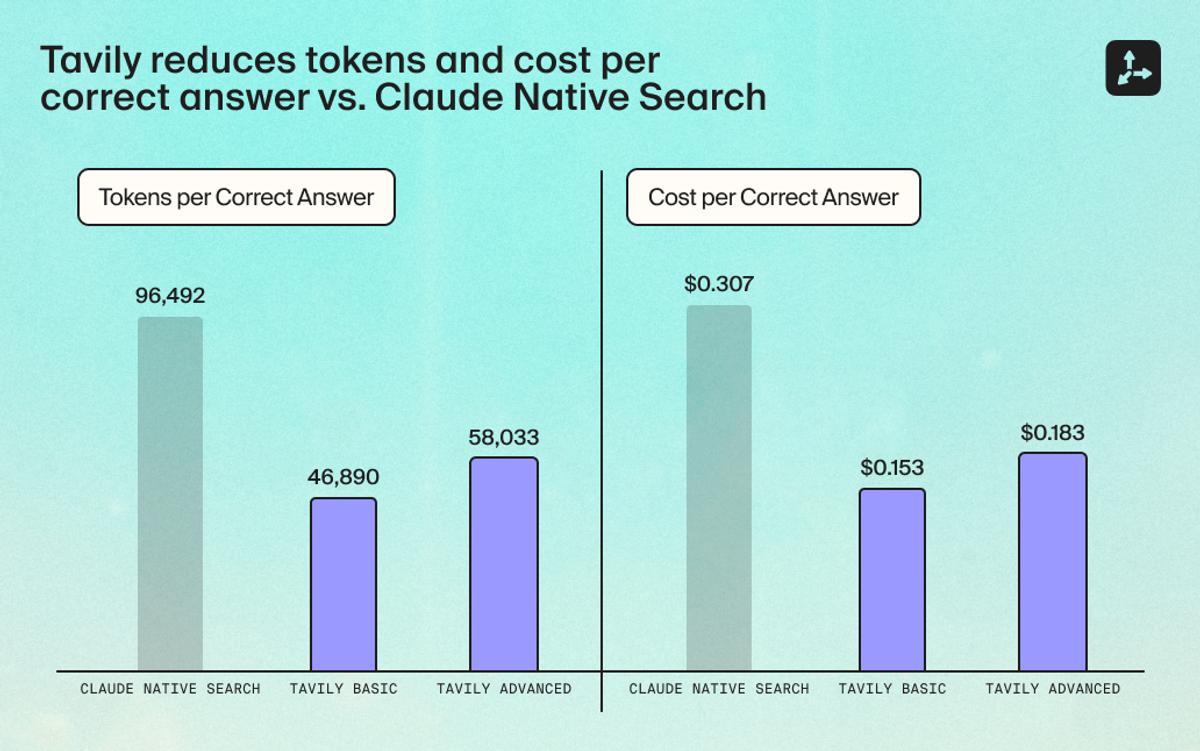
With Tavily Basic powering retrieval, Claude used roughly half as many tokens per correct answer and cost roughly half as much as with Claude’s native web search.
Tavily Advanced delivered the highest accuracy while still costing about 40% less per correct answer than native search.
For production agents making thousands of searches, reducing the cost of each correct answer can translate into significant inference savings at scale.
Control how your agent searches
Claude’s native web search abstracts away much of the retrieval layer. That makes it easy to use, but it also means developers have limited control over how retrieval happens.
With Tavily, search is an explicit part of your application.
Developers can configure parameters such as search depth, number of results, included or excluded domains, time ranges, topics, and the amount of content returned from each source.
That control matters when different agent workflows have different retrieval requirements.
A financial agent might restrict searches to trusted financial and regulatory sources. A news agent might prioritize recently published content. Another workflow might favor faster, lighter retrieval for simple questions and deeper retrieval for harder ones.
Instead of accepting one search behavior chosen by the model provider, you decide how search should work for your application.
See what your agent actually searched
Production agents need observability.
If an agent produces a questionable answer, developers should be able to inspect the retrieval path that led to it:
What did the agent search? Which results came back? Which URLs did it retrieve?
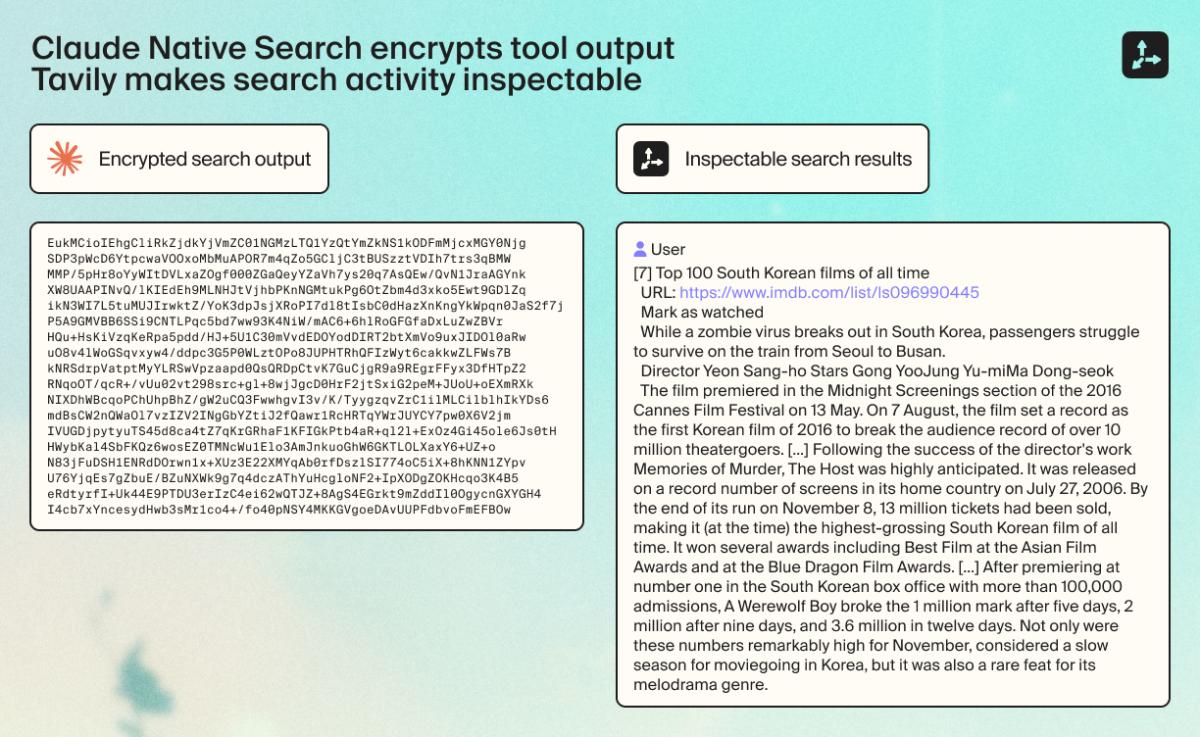
In our evaluation, Claude native search returned fully encrypted tool output, leaving us with zero visibility into the underlying search queries. Tavily exposed the searches performed, search outputs, and URLs retrieved.
That difference becomes especially important when debugging agent behavior, evaluating retrieval quality, or investigating why an agent failed.
Keep search independent from your model
The model landscape changes quickly.
A team might use Claude today, an open-source model running on Nebius tomorrow, and several models for different workloads six months from now.
When search is native to the model provider, your retrieval infrastructure moves with your model.
Tavily separates the two.
The same search layer can sit behind Claude, OpenAI models, Gemini, open-source models, or self-hosted inference. It also integrates with frameworks and protocols including LangChain, LlamaIndex, and MCP.
That means teams can choose the best model for each workload without rebuilding how their agents access the web.
Your model becomes interchangeable. Your retrieval layer stays consistent.
Build retrieval infrastructure for production
Native search has an important advantage: convenience.
If you're prototyping with Claude and simply need to give the model access to current information, Claude's native search can be a great place to start.
But convenience and infrastructure are different requirements.
Once agents depend on the web in production, teams need to think about retrieval as its own layer: quality, information density, configurability, observability, reliability, and portability across models.
That’s the role Tavily is built to play.
Instead of tying web access to whichever model happens to be generating the answer, Tavily gives your agents a dedicated retrieval layer that you can control, measure, and improve independently.