
/Industry5 min read
How Insurance Teams Use AI Web Retrieval to Accelerate Underwriting and Risk Decisions
See how insurance teams use AI web retrieval to accelerate underwriting, enrich renewal profiles, and scale secure, source-cited research.

Before an underwriter can assess an account, someone must research the business. That often means searching for company history, reviewing complaints, checking ownership and locations, and bringing findings together from multiple sources. At renewal, much of that work happens again.
Tavily gives insurance AI applications reliable access to current web intelligence. That means teams can turn fragmented external information into structured evidence, enabling models and underwriters to produce faster research reports, richer renewal profiles, and scalable assistant workflows that would be difficult to build and maintain manually.
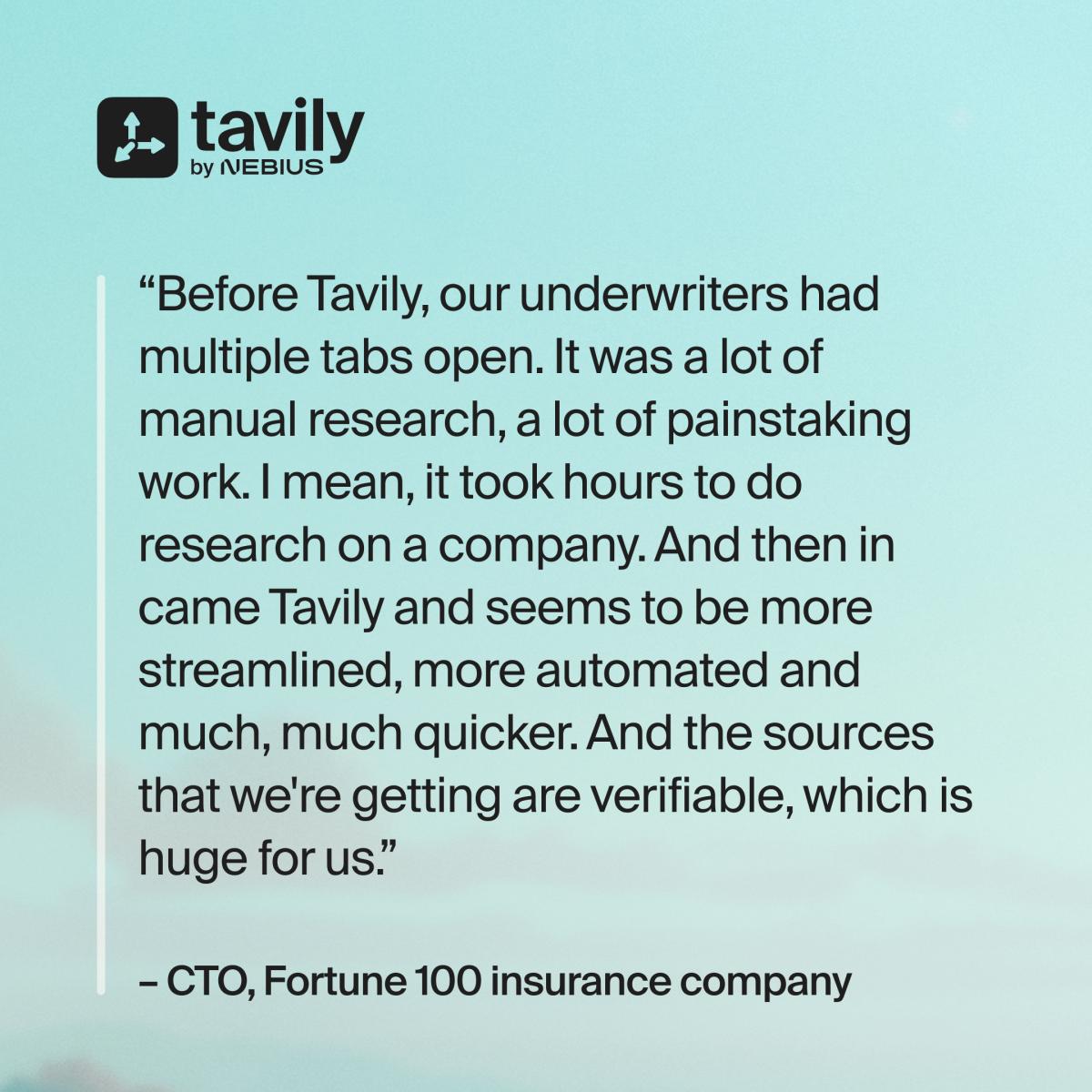
We spoke with the CTO of a Fortune 100 insurance company about the difference AI-powered web research can make. They said:
If your team hasn't connected agents to the live web yet, or you want to see how and what other teams are doing, this blog looks at three ways insurance companies are already using live web retrieval, and how Tavily supports the security and compliance requirements that come with production use.
Turning underwriting questions into a source-cited report
One U.S. insurance and financial-services group uses Tavily in a Deep Research Accelerator for its agribusiness underwriting team.
The application addresses a recurring bottleneck: answering underwriting questions requires searching across sources, checking what is relevant, and assembling the findings into a useful report.
The workflow starts with predefined questions about company history, complaints, organizational structure, and other external risk signals. Tavily powers web research, and the application consolidates the results into a structured, source-cited report for an underwriter to review.
Starting with defined questions gives the research a consistent scope. Organizing findings around those questions makes it easier for a reviewer to see what has been answered, what needs investigation, and which sources support each finding.
For these agribusiness underwriters, this meant finding a company had expanded into a new operation and bringing that information into the next broker conversation. Instead of spending the preparation period gathering background, the underwriters can now focus on what the change means and which questions to ask.
Bringing in Tavily allowed them to move faster from an unfamiliar account to an informed review.
Building renewal profiles that downstream agents can use
Another underwriting company built a company profiler to support renewals. The company described its previous process of assembling this information as extremely slow and manual. Now, the team is able to apply the same research framework to every account, thereby reducing repetitive work by a significant margin.
For each company, the application runs approximately 10 standardized searches using Tavily to cover financial performance, leadership, locations, ownership changes, and M&A activity. Once external information is retrieved, a language model, e.g., Claude, converts the findings into the company’s required structure, and downstream agents use the resulting profile.
The architecture separates three responsibilities: retrieving evidence, organizing it, and using it in subsequent tasks. A consistent profile gives downstream agents a common input, so each step does not need to repeat the same background research.
For a renewal team, this means surfacing an acquisition or a new location that warrants further review. Comparing the profile with the previous account record helps the team focus on material changes instead of rebuilding the company’s history every time.
That creates a practical route to researching more accounts consistently and directing attention toward renewals that need deeper investigation.
Expanding from one chatbot to shared retrieval infrastructure
An American insurance brokerage and risk-management company started with a chatbot that used Tavily Search through the MCP.
After bringing that application into production, it expanded Tavily into workflows involving retrieval and analysis of large volumes of unstructured insurance documents. Its teams now use Search, Extract, Crawl, and Research across applications and divisions.
The company’s adoption moved beyond a single chatbot to a common retrieval foundation for multiple applications. Teams use the same underlying service to support different research and assistant workflows, giving them an established integration to build on as new needs emerge.
That reuse reduces the need for each application to establish its own approach to external data access. Engineering effort stays focused on the research questions, output formats, and review processes that make each application useful.
Expansion also brought governance into focus. The company adopted a division-led approval model to manage access, cost, and risk as demand grew. Ownership and usage controls became part of operating the shared infrastructure.
What other insurance teams can take from these examples
These applications serve different purposes, but follow a similar pattern:
Research questions → web retrieval → structured findings → review or downstream processing
To apply that pattern, start with a recurring task your team already understands. Define the questions, the expected output, and where human review belongs.
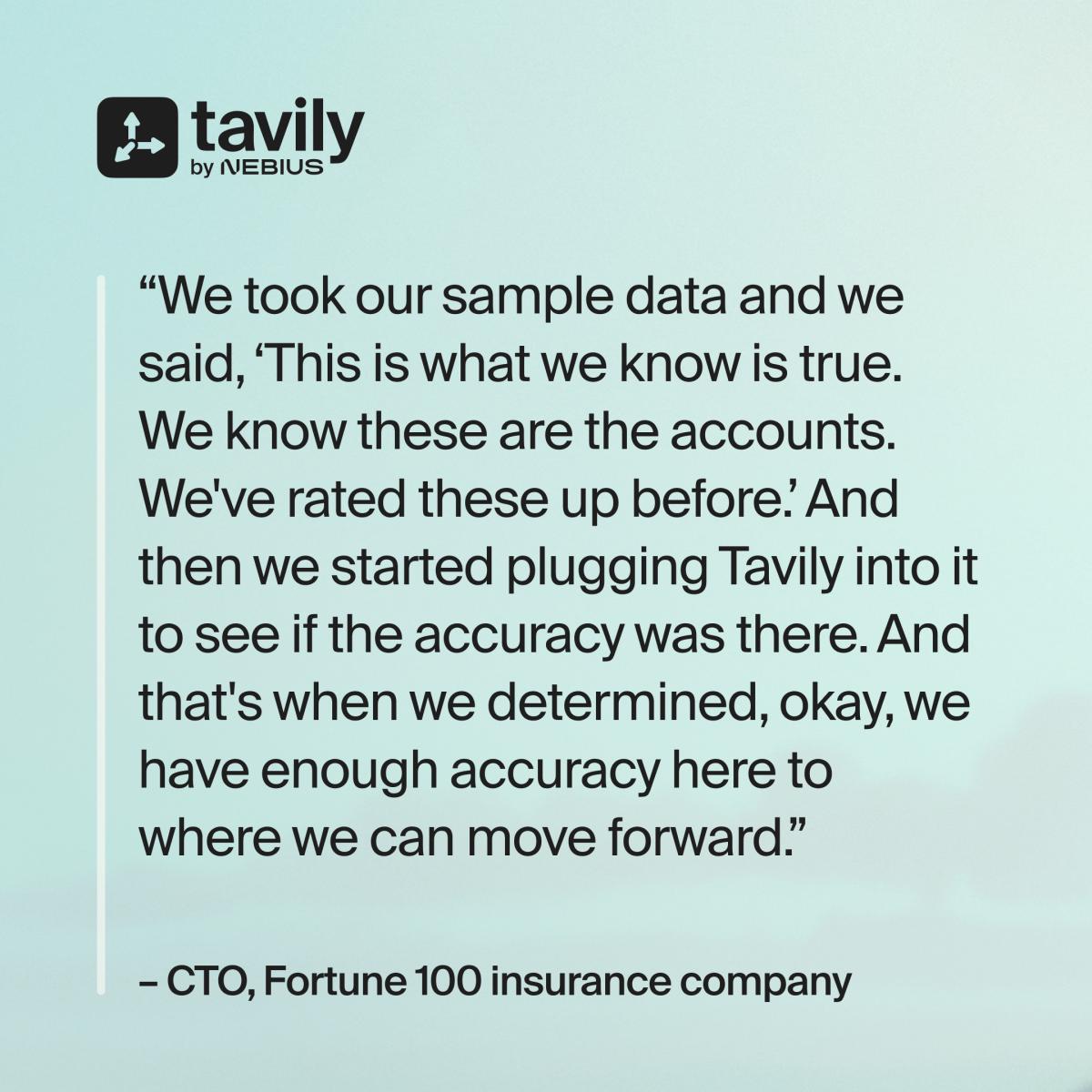
Keep supporting sources connected to material findings as information moves from search results into reports or profiles. Make missing or conflicting information visible and evaluate whether the completed output helps reviewers work more efficiently.
The business measures can stay practical: time spent preparing an account, research completed before renewal, reviewer rework, or engineering effort required to launch another application. Assess security, access, and usage controls alongside those outcomes.
Preserving traceability and supporting security requirements
Underwriters, compliance professionals, and risk reviewers need to understand where a material finding came from before acting on it. An AI answer needs to be useful and citable.
Tavily returns source-grounded web context with source links. Preserving those links in reports and company profiles lets reviewers trace findings back to the underlying evidence. The application gathers and organizes information, while the underwriter reviews the sources and makes the final decision.
Tavily also integrates with existing models and orchestration frameworks, so teams can add current external information to their applications without replacing the rest of their AI stack. Our enterprise security capabilities include Zero Data Retention, prompt-injection protection, PII filtering, and harmful-content filtering.
The security program is independently assessed through SOC 2 Type II and ISO 27001 certification. These assurances and controls support enterprise security reviews alongside the access management, workflow governance, and human oversight established by each insurance team.
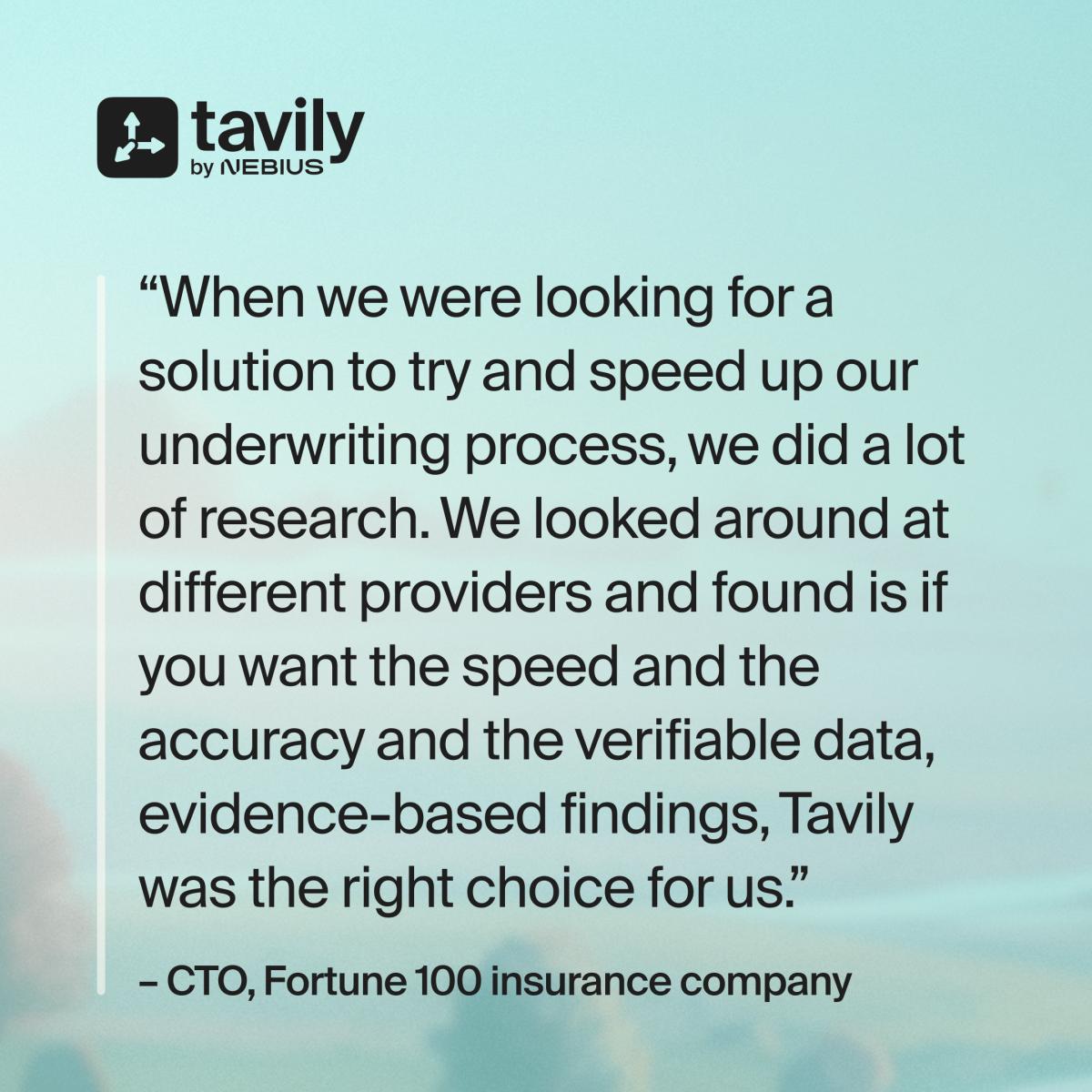
Moving from a research prototype to an insurance capability
These businesses turned recurring research tasks into production applications, using live web retrieval to supply structured, traceable information where their teams need it.
Start by testing Tavily on a research workflow your team already performs manually. Establish the research questions, preserve the evidence, and measure the difference the application makes to the people using it.
Learn more about using Tavily for insurance AI agents, or go straight to testing in the free Tavily playground.