
/Industry8 min read
Agentic Distribution: Your Stairway to Heaven
How do you get AI agents to find and recommend you? Be known, understood, parseable, contextual, and portable. These five steps lead agents to your door, then once they open it, treat them as a real user. Here's how to do it.

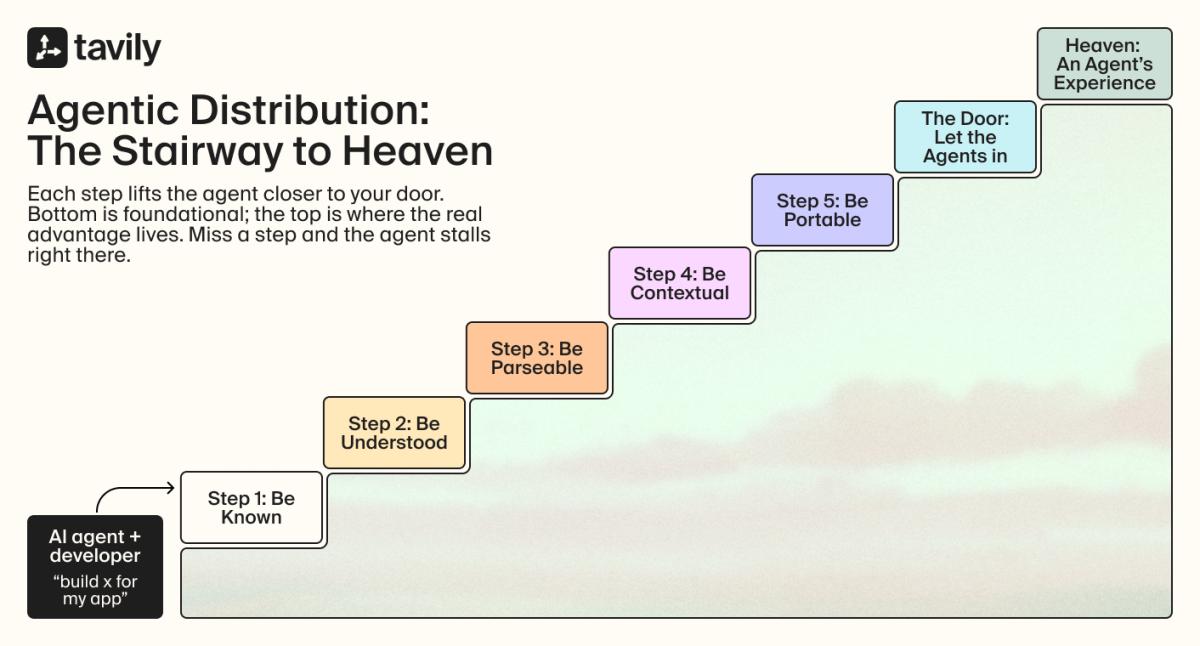
At GTC 2026, Jensen Huang said every company needs an OpenClaw strategy. Same logic applies to agents: every company needs an agentic distribution strategy, making your product something AI agents can find, plug into, and use. When a developer asks an agent to solve a problem, your product should be the one it reaches for.
Software has always been sold to humans: B2C, B2B, B2D. Agents are the next shift, coined as Business to Agent (B2A). They don't wait for a developer to set up access or go through procurement. They find what they need, test it, and either use it or they don't in a split second. Most APIs still assume a human at the keyboard, an account with a name, a credit card attached to a person. That assumption is what agentic distribution has to break.
The shift is already visible in developer tooling, which so far, has been a strong predictor of where AI is heading. A number of companies have started building surfaces specifically for agents, and MCP adoption has grown quickly, with 10,000+ servers and 97M monthly SDK downloads. As a16z puts it, API quality alone may not be enough anymore; discoverability and differentiation increasingly matter when the user choosing your product is an agent.
Here's what actually matters, where the market is today, and the gaps nobody's talking about. These three stages I think of as a stairway to heaven.
The metaphor: stairway to Heaven
Picture an AI agent and a user walking together. Your job as a dev tool company is to build the path they walk on, the door they walk through, and what they find on the other side.
The Stairway is how agents discover you and start recommending you at all.
The Door is the interface the agent walks through. Your CLI, MCP server, Agent Skills, http://AGENTS.md.
Heaven is how good the agent's experience actually is once it's inside.
Most companies pour everything into the Door, ship an MCP server or CLI and call it a day. Far fewer ask whether agents are recommending them in the first place. Almost nobody thinks about Heaven.
Stage 1: The stairway — getting agents to find and recommend you
Before any integration exists at all: a developer tells their favorite coding agent "build X for my app." Does the agent come back with you?
That's not luck. It happens because you built a stairway, one step at a time, each step lifting the agent a little closer to your door. Miss a step and the agent stalls right there. Build them all and the agent drifts toward you on its own.
Here's what the steps look like.
Step 1: Be known | Organic presence in LLM training data
This is the ground floor. If your brand is in the training data, the LLM has a natural preference to choose your product, a superpower none of your competitors have.
What shapes this? Stack Overflow threads, Reddit, GitHub stars, blog posts, whatever the community says about you. Consumer brands already have a funded industry tracking whether ChatGPT recommends a given brand. For developer tools, nothing exists. Nobody can tell you whether Claude Code reaches for Stripe or PayPal when a developer asks about payments. Call it GEO, Generative Engine Optimization for dev tools. It isn't a discipline yet.
Skip this step, and you're not a candidate. The agent doesn't know you're there.
Step 2: Be understood in Documentation that agents can consume
Agents pull from docs that are structured, easy to extract from, and full of examples. A wall of prose with no shape won't get read, the agent will invent an API instead of learning yours.
The fastest way for an agent to understand you isn't better prose, it's letting it try you. Tavily's Keyless tier does this: no API key, no account, no signup, just a capped number of free queries a day before the agent needs credits. The agent doesn't have to take the docs' word for it when it can call the real endpoint and see the real response.
Skip this and the agent knows your name but gets your product wrong.
Step 3: Be parseable | OpenAPI specs and machine-readable contracts
An OpenAPI spec carries the agent from "I've heard of this tool" to "I know exactly which endpoints to hit."
Skip this and the agent will happily recommend you, then have no idea how to call you.
Step 4: Be contextual | AGENTS.md and project-level guidance
Every codebase is its own world. The agent needs to know how this team uses your tool, which endpoints matter here, what patterns this project follows. AGENTS.md and CLAUDE.md are project-level files that answer that — generic knowledge turned into something the agent can act on, here, in this project. Tavily publishes its own at docs.tavily.com/agents.md: specific patterns for wiring search into an agent's codebase, not just a generic API reference.
Skip it and the agent uses you generically, missing the exact patterns that make you worth using.
Step 5: Be portable | Agent skills that work everywhere
Make everything above travel, it should work the same no matter which agent environment the developer is in. Agent Skills, the SKILL.md format created by Anthropic, package instructions that run across agent environments. Tavily ships an official skill set for this.
A well-built SDK with clear naming pushes this further: agents lean into the Matthew Effect. In this case, popular, well-designed tools get recommended more often and used more correctly. The rich get richer.
This step puts the agent right at the door, hand on the handle.
Key takeaway
The stairway is a progression. Be known, be understood, be parseable, be contextual, be portable, each one resting on the one before it. Miss a step and the agent stops there. Most companies leap straight to step three or four without pouring the foundation, and not one of them measures whether the whole thing works.
Stage 2: The door — the interface agents walk through
An agent has decided to use your product. Can it actually get in?
2.1 The current landscape of "doors"
Door type | Maturity | Example | Strengths | Weaknesses |
|---|---|---|---|---|
CLI | Mature | Stripe, GitHub, Vercel, Tavily | Agents use natively, battle-tested, existed pre-agent era | Not designed for agent consumption, output parsing is fragile |
MCP server | Growing fast | 10,000+ servers | Standardized protocol, discoverable, tool descriptions guide agents | Quality varies wildly, security concerns, still early |
Agent Skills | Emerging | Vercel agent-skills.sh repo | Cross-agent, packaged best practices | Adoption still limited, discovery unclear |
REST API + OpenAPI | Mature | Most dev tools | Universal, well-understood | Agents need wrappers, not natively agent-friendly |
SDK | Mature | Every dev tool | Rich, typed, documented | Agents often hallucinate SDK usage, version sensitivity |
2.2 What makes a good door
- Discoverability — Can agents even find your door? In order to do so, they need MCP marketplaces like Smithery, mcpt, and OpenTools, plus the skills registries.
- Tool descriptions — Your MCP tool names and descriptions decide whether an agent picks you. This is the new meta tag. Treat it seriously.
- Authentication — OAuth, API keys, tokens. If the agent can't auth, it can't come in. So ask yourself how your auth flow holds up when there's no human and no browser, just a headless agent.
- Payment — Authentication tells you who's calling. Payment is the next wall, because there's no procurement flow for an agent to go through. Tavily runs this the same way it runs evaluation: a live x402 endpoint at x402.tavily.com (docs) where an agent sends a search request, gets back an HTTP 402 with the price, signs a USDC transfer on Base, and retries — no API key, no account, no subscription, just $0.01 a call settled on-chain in the same round trip.
- Error messages — A good "door" guides the agent on how to open it (through setup), catches the agent when it reaches for the wrong knob, and optimizes the whole experience.
2.3 The multi-door strategy
Each door fits a different place the agent might be living — IDE, terminal, web, or running fully on its own. The smart companies don't pick one. They ship a CLI for terminal agents, MCP for the protocol-native ones, skills for cross-platform reach, and REST for everything left over.
Key takeaway
The door is where everyone's crowding right now. It’s because most of the doors are poorly described, minimally authenticated, and have never been tested against a real agent.
Stage 3: Heaven - what happens after the agent walks in
This is the most neglected stage, and it’s where I see the biggest gaps by far.
When an agent gets through your door, it either starts using your product, or trying to figure out how. Here are a few ways you can help agents get the most out of their Heaven experience:
3.1 Actionable error messages
Most error messages were written for a human squinting at a terminal. An agent needs something different: machine-readable and pointing somewhere. Tell it what broke, what to do about it, and what the valid options are.
For example, when an agent sends an invalid API key, Tavily's server doesn't just reject it; it tells the agent exactly where and how to fix it.
3.2 Management API
Can an agent run the lifecycle of your product? Spin up projects, change settings, check status, or read logs?
Plenty of products nail the usage API — make a payment, run a query — but have nothing for management: create an account, set up a webhook, configure an environment. That’s where you can really stand out. By adding a management API, the agent can not only use your tool, but it can also set it up, which is a valuable capability many vendors leave out.
3.3 Agent abuse infrastructure
Agents at scale don't behave like people. They retry hard, and the traffic looks different as they hit your rate limits in strange shapes.
So: do you have rate limits designed for agent-driven usage? Token-based metering? Abuse detection that understands the difference between normal human usage and automated, agentic traffic? Agents can generate far more requests than a human user, and that can show up very quickly in your infrastructure costs and billing. If your rate limits and usage controls still assume a human at the keyboard, they probably need another look.
3.4 Agent analytics and segmentation
Which agents play well with your product, and which ones fight it? Claude Code might call your API cleanly while Copilot is busy inventing endpoints that don't exist.
Are you even tracking it - agent type, success rate per agent, where they tend to fail, the tool-call sequences they run? Because that data is gold. It tells you which doors to fix, which agents to optimize for, and exactly where your docs are failing.
3.5 The feedback loop
All of that interaction data should loop back and improve the Stairway and the Door. If Claude Code keeps faceplanting on your auth flow, that's a signal to fix the auth tool in your MCP server. If agents never stumble onto your real-time feature, your tool descriptions are burying it.
Nobody has this loop running today. Not really.
Key takeaway
Heaven is where the real advantage lives. Shipping an MCP server is easy now; everyone's done it. Almost no one is thinking past the threshold — about error quality, management APIs, abuse detection, the agent-specific analytics. That's the open ground.
Building from stairway to Heaven
The companies that win this won't ship an MCP server and clock out. They'll build the whole journey:
- Stairway — Agents recommend you organically and through paths you deliberately built to measure.
- Door — Ship more than one integration surface. Make each one discoverable, well-described, and properly authenticated.
- Heaven — Treat the agent as a real user. Actionable errors, a management API, abuse protection, and analytics built for agents.
Today every company investing in agentic distribution is flying blind. Whoever cracks measurement across all the stages first gets an edge the rest will wish they had.
Want to see what an agent-native door looks like in practice? Tavily's Keyless access lets any agent run 30 free searches a day with no API key, no account, and no signup. Get started with Tavily.