
/Product6 min read
How to Choose the Right Web Search API for Financial AI Agents
Not all web search APIs are built for production financial AI. Here's how to choose the right retrieval layer for agents in investment research, AML, and risk workflows.

Financial AI agents are moving into production across investment research, Anti-Money Laundering (AML), Know Your Customer (KYC), risk, and compliance. These systems used to be pilots you could shut down if they misbehaved. Now they're informing live decisions, and sooner or later, someone in compliance, risk, or internal audit is going to ask where the answer came from.
Once an agent is in production, the retrieval layer stops being an implementation detail. It's the evidence base your agent reasons over. Get it wrong, and the problems cascade into accuracy, latency, auditability, engineering complexity, and ultimately downstream model performance.
To get this right, teams should evaluate retrieval before they build. You can run your own accuracy and freshness evaluations, probe auditability and control, and understand exactly how the retrieval layer behaves before it becomes part of a production compliance or risk workflow.
Here's a framework for making that evaluation, organized around three decisions.
Not all search APIs solve the same problem
"Web search API" gets used as a catch-all, but the products underneath it are optimized for different jobs, and the optimization target matters more than the category:
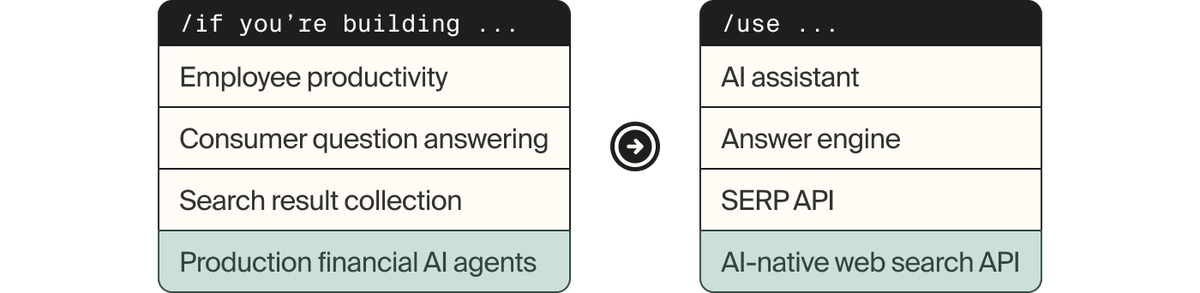
An AI assistant is tuned to make a person faster at their job. An answer engine produces one good answer to one question. A SERP API returns a ranked list of links, the way it always has. None of these are tuned for what a financial agent needs at runtime: structured, sourced, machine-consumable evidence a model can reason over — and a human can reconstruct later.
The rest of this piece walks through why, using three decisions that come up whenever a team wires an agent up to the live web.
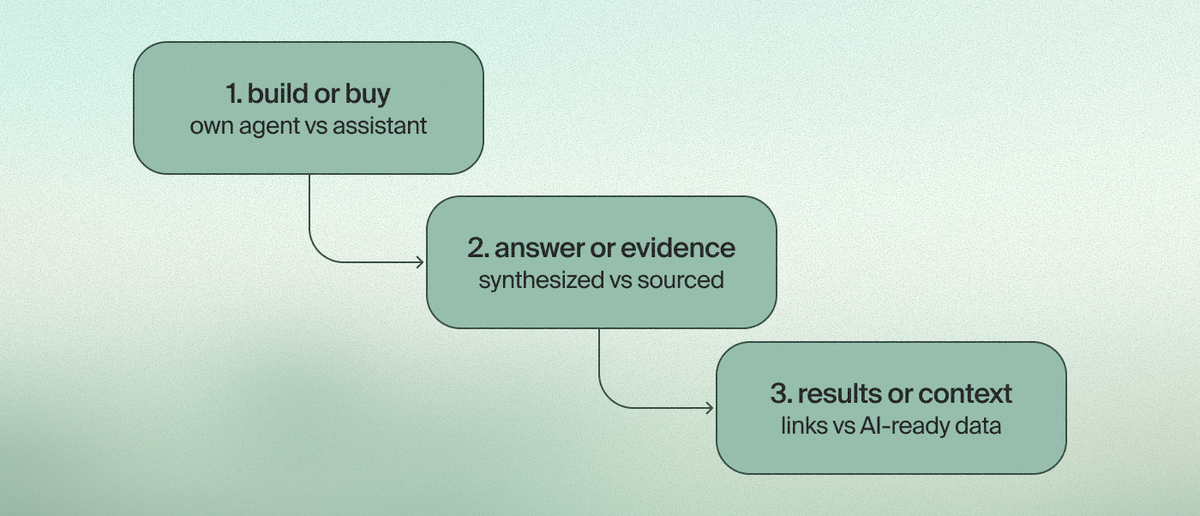
Decision #1: Should you build your own agent or buy an AI assistant?
If the job is summarizing documents, powering internal chat, or general productivity, consider buying an assistant. You don't need to own a retrieval stack to make an analyst's inbox move faster.
The calculus flips once you need proprietary workflows, multi-step agents, prompts tuned to your domain, model routing, your own evaluation harness, or orchestration across tools and data sources. At that point, retrieval isn't a chat window an employee opens; it's a component called from inside your own agent loop, and an assistant can't be bent to fit that shape.
$1M in savings at a global investment firm
A global investment firm evaluated deploying Microsoft Copilot for investment research, but decided to build their own agent instead, using Tavily as the retrieval layer underneath it.
Research that took analysts a week to complete, now takes 15 minutes, across coverage of 20,000+ companies and 1,500 users. Instead of analysts manually searching the web, opening filings, and stitching together notes, agents issue parallel searches and retrieve structured, source-attributed context that downstream models can immediately reason over. The result is roughly $1M in projected savings.
Decision #2: Does your agent need answers or auditable retrieval?
This is the distinction that trips up teams migrating from consumer-grade tools into regulated workflows.
Answer engines optimize for one thing: give the user the best answer. That's the right objective when a person asks a question and moves on. Nobody needs to reconstruct that answer for an examiner six months later.
Financial agents have a different downstream consumer: a compliance officer, a risk committee, eventually a regulator. That changes the objective to giving the agent evidence it can show its work on.
The problem with blending sources
Concretely, an answer engine is free to blend three sources into one clean sentence, and it usually does, because that's what makes for a good answer. But if a claim in that sentence turns out to be wrong, you can't tell which of the three sources it came from. For a research memo, that's an annoyance. For an AML flag, it's a failure the audit will find.
That's the whole argument for optimizing on retrieval instead of answers. Every claim needs a source you can point to. The same query should produce retrieval you can compare across runs during evaluation or incident review, and retrieval quality must be measurable independently of whatever the LLM does with it afterward.
Unfortunately, none of that is free, but it is worth the cost. Sourced evidence is messier to consume than a synthesized paragraph. An agent built this way has to do more of its own reasoning over raw material rather than getting a pre-digested answer. That's a real cost. But the cost becomes worthwhile when you can answer "why did the model flag this" with something other than "the LLM said so."
A case for tracing sources from a top Canadian bank
A top Canadian bank built AML workflows where agents pull adverse media, sanctions updates, and corporate registry changes to support investigator decisions that examiners will eventually review. Engineering rejected an answer-engine-style approach for exactly the reason above: when three sources get blended into one synthesized line with no way to trace which fact came from where, an investigator can't defend the flag, and neither can the bank. What they needed instead was retrieval that preserved source-level attribution, so every flag traced back to a specific document, at a specific time. And that is what they found when powering their agents with Tavily.
Decision #3: Do you want search results or AI-ready context?
This is where SERP APIs come in, and where teams tend to underestimate the cost of "we'll just build the pipeline ourselves."
A SERP API gives you a list of links, not AI-ready context. From there, you still need to scrape pages, handle JavaScript rendering, clean boilerplate, deduplicate stories, chunk content, and re-rank it before an LLM has something useful to reason over. Skip any of those steps and retrieval quality suffers.
Every stage adds another dependency, another network call, and another component to monitor and maintain. AI-native retrieval collapses that pipeline into a single API call that returns structured, machine-readable context, because it's designed to feed models rather than humans.
That said, it's not a free lunch. You're trading some pipeline control for significantly less operational overhead.
Leading wealth manager’s risk model needs
A leading North American wealth manager needed retrieval for stress testing and forward-looking risk models. The workflows depend on live news, filings, macro events, and regulatory updates. It seems simple, but macro and regulatory content can change within hours, and a hand-built scraping pipeline re-cleaning that content on every run is fragile in a specific way: a single site redesign can break a scraper, and nobody notices until a data source is missing from a risk model. Using Tavily, the organization now gets structured and fresh, source-attributed context their agents can use directly, without owning that failure mode.
Shift your focus to what matters most
Every team discussed here started from a different problem. Investment research speed, defensible AML evidence, live macro signals for risk models. But they converged on the same architecture: using Tavily to access the live web. The reasons were consistent too. They needed compliance (full auditable logging, confidence scores, source citations) and control over how web data gets retrieved inside their own agent workflows.
Choosing a retrieval layer built for production AI agents lets your team spend less time maintaining scraping infrastructure and retrieval pipelines, and more time improving evaluation, orchestration, and the workflows that actually differentiate your firm.
The best way to evaluate retrieval is on your own workloads. Learn more about using Tavily for your financial AI Agents, or test what Tavily can do for you and your team for free in the (secure) Tavily playground.